Kurdish Text-to-Speech in 2026: Dialects, Voices, Pricing and How to Choose
A practical guide to Kurdish text-to-speech in 2026: how Kurmancî, Soranî and Kirmanckî voices are built, how much audio a plan really gives you, and a 7-point test to run before you choose a tool.
Kurdish is spoken by 30–40 million people, yet for most of the last decade the big speech platforms offered no Kurdish voice at all. That has changed: in 2026 natural Kurdish text-to-speech (TTS) exists for all three major dialects, and the question is no longer whether a computer can read Kurdish aloud but how well, in which dialect, and what it should cost.
This guide explains how Kurdish TTS works under the hood, what separates a good Kurdish voice from a robotic one, what mazdek AI offers today, and a short test you can run on any tool — ours included — before you commit to it.
Why Kurdish text-to-speech is harder than it looks
Kurdish is not one written language. Three things make it unusually demanding for a speech engine:
| Dialect | Script | Where it is written | What the engine must handle |
|---|---|---|---|
| Kurmancî (Northern Kurdish) | Latin (Hawar alphabet) | Turkey, Syria, diaspora | Letters like ê, î, û, ş, ç and the bare x, q, w sounds |
| Soranî (Central Kurdish) | Arabic-based | Iraq, Iran | Right-to-left text, written short vowels, letters like ڵ, ڕ, ۆ, ێ |
| Kirmanckî / Zazakî | Latin | Turkey (Dersim, Bingöl, Diyarbakır) | Its own grammar and vowel system — not a Kurmancî spelling variant |
On top of that comes text normalization: numbers, dates, currency, abbreviations and loanwords have to be expanded into the right words in the right dialect before any voice can read them. "1999" is not pronounced the same way in Kurmancî and Soranî, and an engine that skips this step sounds robotic no matter how good its voice is.
Finally, there is data. General-purpose voices are trained on thousands of hours of English. Kurdish has a fraction of that, so every serious Kurdish TTS is a fine-tuned model built on a hand-collected corpus — the size and cleanliness of that corpus is what you are really paying for.
How a modern Kurdish voice is built
Under the hood, today's Kurdish engines follow the same pipeline:
- Normalize the text (numbers, dates, script-specific letters, punctuation).
- Predict prosody — where the stress falls, where to pause, how the sentence rises and falls.
- Synthesize audio with a neural model (flow-matching models such as F5-TTS have replaced the older concatenative and Tacotron-style systems).
- Clone or select a voice from a short reference recording — this is how one model can offer hundreds of distinct voices.
At mazdek AI, Kurmancî and Kirmanckî run on our own F5-TTS fine-tune, trained on studio-quality Kurmancî recordings. Soranî runs on a separate F5 fine-tune with a catalog of 1,200+ voice identities. Every other language (80+) routes to a multilingual engine. The Kurdish models run on our own GPU workers — which is why Kurdish characters are inexpensive on our plans, and why the voices keep improving with each retrain rather than waiting on a third party.
What mazdek AI covers, dialect by dialect
Speech is only useful when the rest of the language stack is there too. This is what one mazdek AI account gives you for each dialect:
| Kurmancî | Soranî | Kirmanckî / Zazakî | |
|---|---|---|---|
| Text-to-speech | yesown F5 model | yesown F5 model, 1,200+ voices | yesKurmancî-trained engine |
| Speech-to-text | yesfine-tuned Whisper | yesfine-tuned Whisper | yesKurmancî model |
| Translation | yesto and from 255 languages | yes | yes |
| Document / photo OCR | yesLatin script | yesArabic script | yesLatin script |
| AI assistant (chat) | yes | yes | yes |
| Live interpreter (two-way speech) | yes | yes | yes |
| Daily spoken news brief (Rojev) | yes | yes | yes |
| Web · iOS · Android | yes | yes | yes |
- Translation255 languages
- Speech-to-text (90+)90 languages
- Text-to-speech (80+)86 languages
- Document OCR6 languages
Kurdish dialects are counted inside each total. Translation covers 255 languages; speech recognition and text-to-speech cover Kurmancî, Soranî, Kirmanckî plus 80+ other languages.
Kirmanckî deserves a special mention. Roughly 2–3 million people speak it, it has its own literature and radio, and it is usually the first thing left out of "Kurdish" products. mazdek AI reads it, transcribes it and translates it on every plan, including the free one.
How much audio do you actually get?
TTS is sold by the character, but people think in minutes. A useful rule of thumb for Kurdish: about 900 characters of text make one minute of finished speech at a natural reading pace.
- Free — 40,000 characters45 min
- Pro $19.99 — 750,000 characters830 min
- Max $79.99 — 3,000,000 characters3,330 min
Kurmancî / Soranî / Kirmanckî text-to-speech allowance converted at ≈900 characters per minute. Multilingual voices have their own, separate allowance.
Two things worth knowing before you compare any plans:
- Kurdish and multilingual voices are metered separately. Kurdish runs on our own models and is generous; the multilingual engine is a metered third-party service and has its own, smaller allowance. If your workload is mostly Kurdish, that split works in your favour.
- Speech is bundled with the text side. The same plan includes speech-to-text minutes, translation characters, the AI assistant, OCR and — on Max and Enterprise — the live interpreter, so you are not stacking three subscriptions to get one workflow.
- Kurdish text-to-speech40,000 characters
- Translation12,000 characters
- Multilingual text-to-speech3,000 characters
Kurdish text-to-speech, translation and multilingual text-to-speech allowances on the free plan. Speech-to-text (10 minutes) and the AI assistant are included as well.
How to choose: a 7-point test
Run every candidate — including mazdek AI — through the same short test with your own text:
- Dialect and script. Paste a Kurmancî paragraph, a Soranî paragraph and, if you need it, a Kirmanckî one. Does the tool even accept all three?
- Numbers and dates. Include "25 Tebax 2026", a phone number and a price. Digit-by-digit reading is the most common failure.
- Names and loanwords. Place names (Amed, Hewlêr, Qamişlo) and Turkish, Arabic or English loanwords expose weak normalization.
- The hard letters. In Kurmancî, listen to bare x (xanî), q (qenc) and w; in Soranî, listen to ڵ and ڕ.
- Long text. Paste 3,000 characters. Does the audio stay stable, or does it repeat, skip or drift?
- Rights and privacy. Can you download the file? Can you use it commercially? Where is your text stored? (mazdek AI is operated by a Swiss company under GDPR; user audio lives in a private bucket and is served only through short-lived signed links.)
- What you will need next month. Transcription, translation, subtitles, an interpreter — buying them separately costs more than a bundle.
What Kurdish speech is used for
- Education — reading textbooks and exercises aloud for learners, and for people who cannot yet read the script.
- Accessibility — screen-reader-style reading for blind and low-vision Kurdish speakers, a need the community has voiced for years.
- Media — dubbing, bulletins and social clips in a language where voice talent is scarce and expensive. Our own daily brief, Rojev, is produced this way in 15 languages every morning.
- Interpreting — two-way spoken translation for clinics, courts, municipal offices and family calls between the diaspora and home.
- Archives — the reverse direction: transcribing decades of Kurdish television so it becomes searchable text.
Try it
You can test Kurmancî, Soranî and Kirmanckî voices on the mazdek AI demo page without creating an account, and the free plan covers 40,000 Kurdish characters a month. If your team needs volume, API access or a data-processing agreement, talk to us.
Frequently asked questions
- Is there a free Kurdish text-to-speech tool?
- Yes. mazdek AI's free plan includes 40,000 characters of Kurmancî, Soranî or Kirmanckî speech per month — about 45 minutes of audio — with no card required, plus speech-to-text, translation and the AI assistant.
- Which Kurdish dialects can be turned into speech?
- Kurmancî (Northern Kurdish, Latin script), Soranî (Central Kurdish, Arabic script) and Kirmanckî/Zazakî (Latin script). mazdek AI supports all three; Kirmanckî is read with the Kurmancî-trained engine.
- How many characters is one minute of Kurdish speech?
- At a natural reading pace, roughly 900 characters of Kurdish text produce one minute of audio. 40,000 characters is about 45 minutes; 750,000 characters is close to 14 hours.
- Can Kurdish TTS read numbers, dates and abbreviations correctly?
- Only if the tool normalizes text before synthesis. A good Kurdish engine expands 1999 into words, reads dates in the dialect's own pattern and handles the Latin/Arabic script difference. Test it with your own text before you commit to a plan.
- Is the audio commercially usable?
- On mazdek AI, audio you generate on a paid plan is yours to use in your own content and products; the free plan is for personal and evaluation use. Always check the terms of any provider you use.
- Does it work on a phone?
- Yes — mazdek AI runs on the web, iOS and Android with the same account and the same allowances.
Related articles
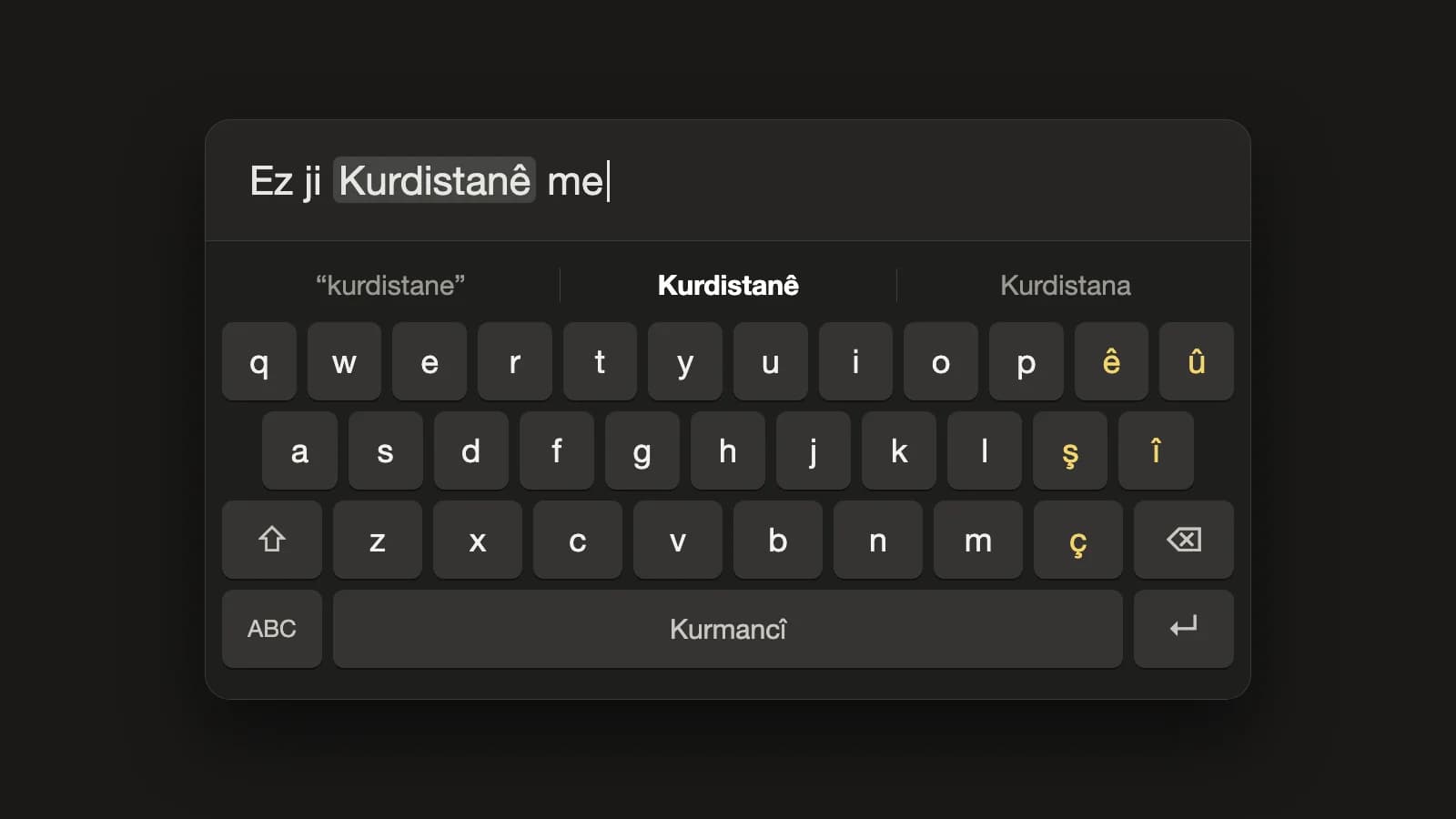
mazdek AI Keyboard: a Kurdish keyboard for iPhone and Android that adds the missing letters for you
A Kurdish system keyboard is now part of the mazdek AI app. Kurmancî, Soranî and Kirmanckî layouts, word suggestions, and autocorrect that turns “kurdistane” into “Kurdistanê” — in WhatsApp, Instagram, Telegram and every other app. Everything runs on the phone; nothing you type leaves it.
- #kurdish-keyboard
- #kurmanci
- #sorani
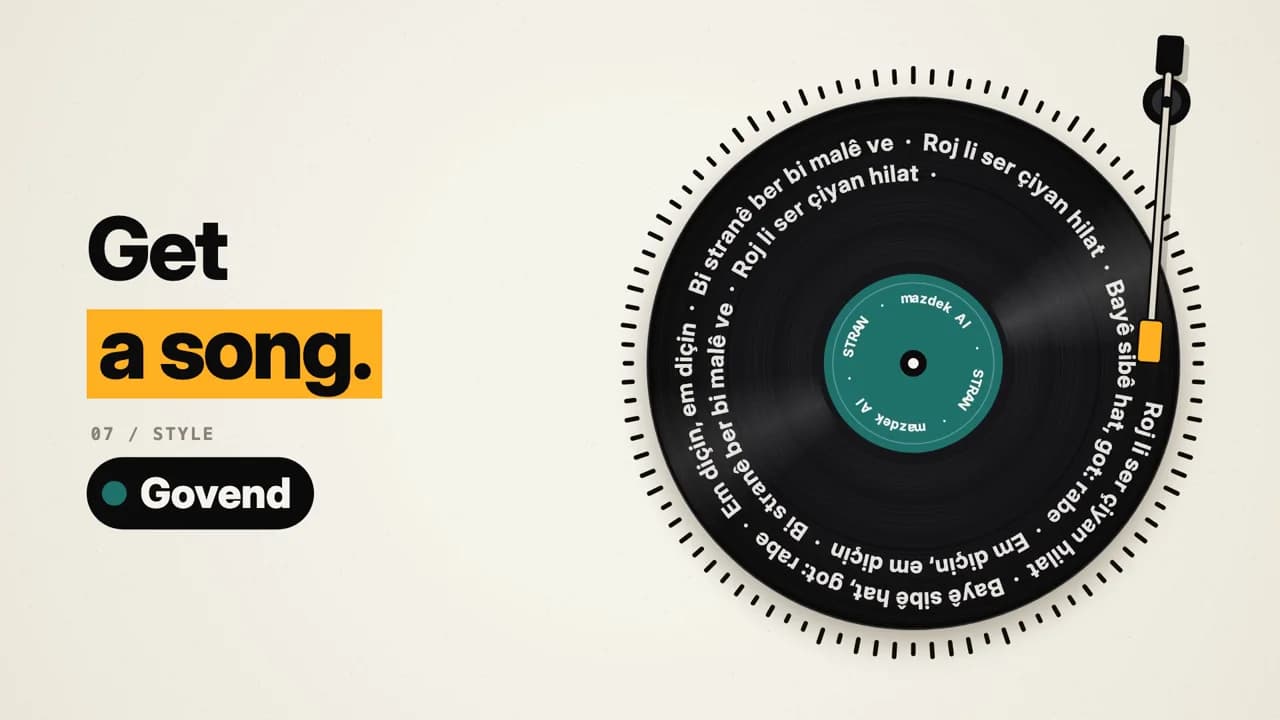
How to Turn Your Lyrics into a Kurdish Song with AI (Dengbêj, Govend, Lorî) in 2026
A practical guide to making a full Kurdish song from your own lyrics: how to structure verses and a chorus, which Kurdish styles to pick — dengbêj, govend, lorî, heyran, saz ballad — what the Standard and Awaza Kurdî modes are for, and what the free and paid plans include.
- #song-generator
- #kurdish-music
- #dengbej
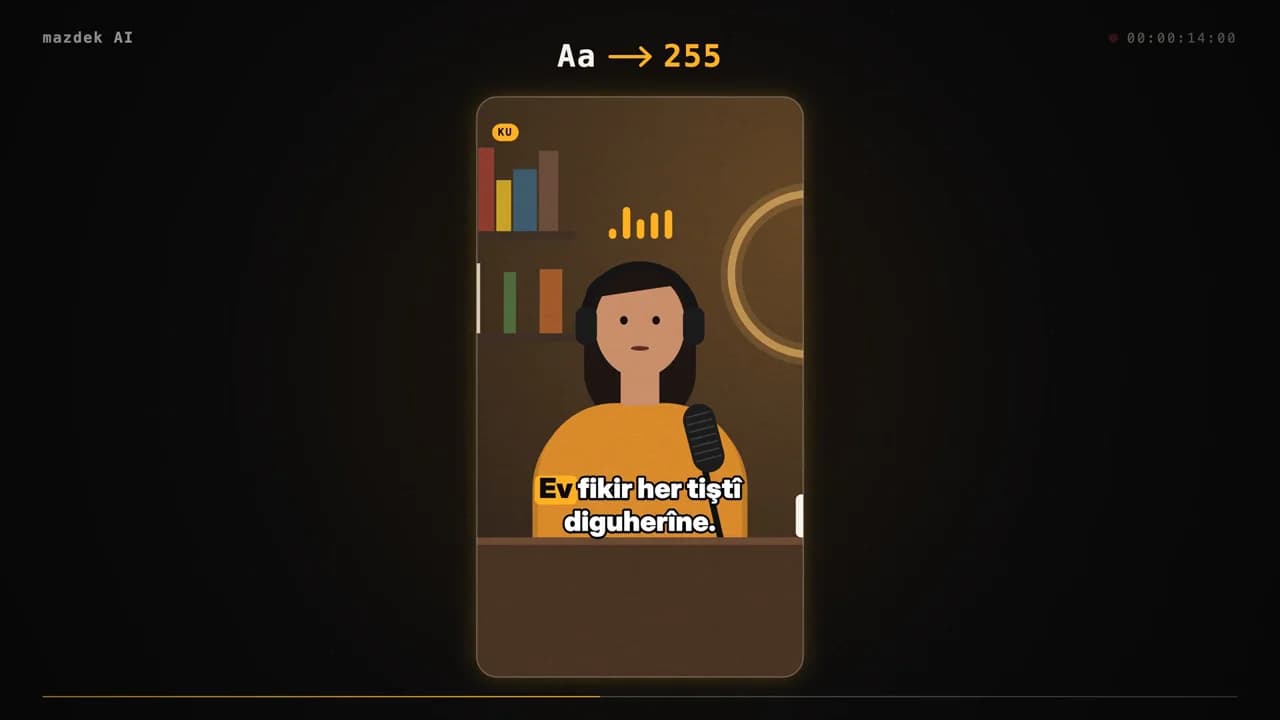
How to Turn a Long Kurdish Video into Short Vertical Clips (TikTok, Reels, Shorts) in 2026
A practical guide to cutting short vertical clips from a long Kurdish interview, podcast or stream: how AI finds the best moments, how Kurmancî and Soranî karaoke captions work, which layouts fit which platform, and what the free and paid plans include.
- #video-clips
- #short-video
- #subtitles